top of page

Hello everyone,


Over the past two weeks, students learned about the Origins of the Earth, the Moon, the Sun, Eclipses, Tides, and Seasons/Day/Night. We just finished part one of Astronomy and had our first "large" quiz on these topics. After the break, we'll begin with part two of Astronomy. Part two focuses on Planets, Kepler's Laws of Planetary Motion, Small Celestial Bodies such as Comets, Meteors, Asteroids, Moons, and Dwarf Planets, the Life of a Star, and H-R Diagrams. This part of astronomy will move quickly, and we will finish the unit before PSSA testing. During PSSA testing, I plan to have students work on an Astronomy stop motion project using whatever materials students would like, I'll provide materials like playdoh and other things for the project. It is a low-key, creative, and fun project to do during PSSAs before moving into our final unit of the year!


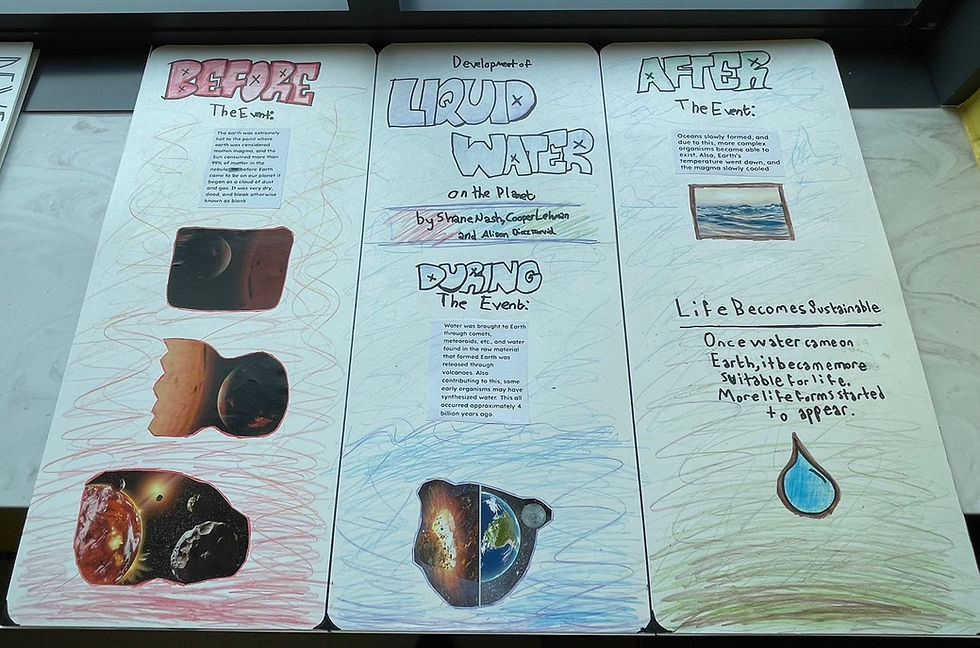
Below is an image of some fantastic posters from the Origins of the Earth posterboard project that we did:

ree

Below are some photos from our Moon Phases lab
After Astronomy, we will move into our Natural Disasters (Catastrophic Events) unit.


I hope everyone has a wonderful break! Enjoy the warmer weather!


Thank you,

Mr. Silverwood
 
 
  • Mar 22, 2023

Hello everyone!


Since the last post, students have started their Astronomy unit! We investigated space exploration last week and watched the Challenger: Lost Tapes film on Disney+ that uses real news and interview footage of the astronauts on that mission who unfortunately passed due to the terrible explosion and malfunction with the O-rings on the rockets. Watching this film allowed them to consider whether Space Exploration is worth the risk. A quote from that mission by Ronald Reagan states, "The future doesn't belong to the fainthearted; it belongs to the brave". We discussed the meaning of that quote and about the current Artemis missions to once again have humans back on the Moon!


This week, we explored the Origins of the Earth! Students were broken up into 9 different groups exploring 9 topics that scientifically explain the possibilities of how the Earth formed and how it became the habitable planet that we know and love today! Below is an example of one of the posters that I thought looked really cool.

ree

I plan to make a large timeline out in the hallway using some of the best-designed posters with the most accurate information. That picture will be in the next blog post. Friday, students are going to do rotations and take notes on the Sun!


Next week, students will be exploring why seasons occur! If you didn't realize, the Spring Equinox just occurred Monday on the 20th. The past couple of days has been great with such spring-like weather. We are going to dive into why we have seasons, why the length of day and night changes throughout the year, learn about the orbit and rotation of the Earth, and start discussing the Moon by the end of next week.


Part 1 of Astronomy will come to a close on our next Early Dismissal day before Easter break. The remainder of Part 1 focuses on everything stated above, but also on Tides and Eclipses. When students return from Easter break we'll start Part 2 which focuses on Planets, Celestial Bodies (Dwarf planets, moons, asteroids, meteors, comets), and the Life of a Star. Part 2 will end right before PSSAs at the end of April. After we finish with Astronomy, students will be creating a stop-motion video project on different Astronomy topics! It should be a really fun project for them all!


Well, until next time... if you have any questions feel free to email me at curtis_silverwood@conestogavalley.org


Feel free to follow @sciencewithsilverwood on Instagram to see images of classroom updates, student activities, etc.


Thank you,

Mr. Silverwood


Hello everyone,


I hope things are going well for everyone! Trimester 2 just came to a close. I am finalizing grades on Friday. Students who have an "X" for anything in the grade book can still turn in that missing work for partial credit. Please check with your student to see if they have anything to turn in. They MUST turn it in by Friday.


We recently finished one of our longest units, the Weather & Climate Unit. Our test was last Friday. This week, I wanted to have a buffer week between Trimesters so students could prepare themselves mentally for a new unit. Therefore, Monday and Tuesday we watched the documentary "David Attenborough: Life on Our Planet". Today and tomorrow students are researching and preparing for a debate on Friday over some of the critical questions that the film proposes. One question is whether humans are responsible for the changes we see on our planet, and the other asks whether the world can 100% switch to alternative energy instead of fossil fuels for a sustainable future.


BELOW: The trailer for the documentary we watched, it is a really fascinating film. If you're interested in watching it, it is on Netflix. (Rated PG)

Each class was randomly placed into a group either for the affirmative or the negative for each of the above questions. Friday, two groups will debate while the other two are the judges. Then they will all switch roles! It should be fun and engaging. I'm very excited to see what research students have found and discuss whether any of their prior thoughts/opinions about these topics have changed!


Next week, we will be moving into our Astronomy Unit! Students are going to learn about space, Earth and Sun interactions, celestial bodies, planets, etc. Students seem to be pretty excited about this unit! It should last about 4-5 weeks and there WILL NOT be a big unit test. Astronomy will be similar to our Forces Unit and there will be TWO large quizzes for each "part" of the unit.


After Astronomy, we'll be finishing the year with our Natural Disasters Unit (previously called Catastrophic Events). This unit will focus on some geology and ocean science topics.


As always, if there are any comments/questions you can email me at curtis_silverwood@conestogavalley.org


Thank you,

Mr. Silverwood


© 2025 by Curtis Catwood. Created with Wix.com

bottom of page